
Osprey Nest Building & Relocation
Cape Coral
Sanibel Island, Punta Gorda
& Surrounding Areas
What Ospreys Are
The Osprey is a large, beautiful raptor that is sometimes referred to as a “fish hawk” because they eat mainly fish. Technically, they are not hawks; Ospreys belong to their own family, Pandionidae.
The Osprey (Pandion haliaetus) is a particularly large raptor, with the ability to hunt over both water and land. Because of their ability to hunt over the water and catch fish, they are sometimes referred to as a sea hawk, fish eagle or fish hawk. An Osprey prefers hunting over water, and their diet consists mainly of fish, making the canal, ocean, Gulf of America, rivers, and lake shorelines of Florida a particularly tempting place to nest.
Habitats that cater to the Osprey lifestyle include areas close to the ocean, salt marshes, rivers, canals, estuaries, lakes and ponds.
Example scenarios we work with include hurricane ravaged areas with new Osprey platforms, water-based Osprey platforms to help eliminate roof and boat nesting, and complex installs in heavily developed areas.
Nesting Behavior
Ospreys adore hunting over water and building their nests along shorelines; but certainly are not shy about having a natural nest or artificial platform many miles away from water.
Osprey nesting habits usually result in nests built in the open and high in the air.
The many bodies of water found around Florida, including those found in places like Cape Coral, Fort Myers, Fort Myers Beach, Sanibel Island, Naples, Boca Grande and Pine Island, provide Ospreys with plenty of places to nest and hunt.
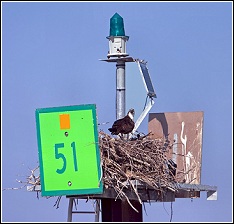
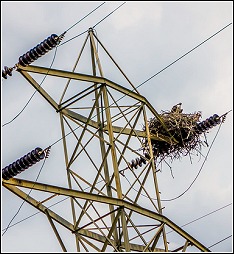
Heavily developed areas work in the Osprey’s favor and they are quick to take advantage of the nest building opportunities that power lines, transformers, telephone poles, intracoastal markers and similar construction provide.
Nest Size & Weight
An artificial nesting platform or natural Osprey nest is very large and heavy, oftentimes weighing hundreds of pounds. Osprey nesting habits can result in nests as large as 5’ in diameter, 2’ to 6’ deep and weighing over two hundred pounds.
Add to that where they like to build their nests and you have a formula for disaster in some cases.
Where Ospreys Nest
Parking lot lights, stadium lighting, radio towers, boats, yachts, marinas and boat lifts are popular nesting sites as well.
Ospreys thoroughly enjoy rusting out rectangular chimney caps as well as the valleys, nooks and crannies of metal roofs.
An Osprey nest is usually built near or over the water, so that makes areas like Venice, Sarasota, Bradenton, Punta Gorda, Boca Grande, Pine Island, Cape Coral, Fort Myers, St. James City, Bokeelia and Fort Myers Beach particularly tempting locations.
In many cases, development can be a problem for wildlife, but the Osprey is quick to take advantage of it. Development means telephone poles, electric lines, billboards, light poles, channel markers and communication towers - all of which provide the perfect place to build a nest - at least as far as the Osprey is concerned. Some osprey will even nest on top of boats and yachts!
Why Removal Alone Does Not Work
Ospreys are protected under the U.S. Migratory Bird Treaty Act. You cannot simply knock a nest down whenever you want—especially if eggs or young are present.
Even when removal is legally possible, without a better alternative nearby, the same birds (or new ones) often re-build on the same structure or the next closest one.
Bird spikes do not work
DIY gadgets waste money. See our nuisance Osprey page for real prevention strategy and timing.
Building an artificial nesting platform in a safer nearby location is an accepted approach—but legitimate Osprey prevention still matters. Put the bird spikes down and walk away.
Platform Installation As The Solution
Osprey platforms not only bring the beauty of these majestic animals into your yards, but will also prevent inappropriate nesting on your roof, chimney or other inappropriate structures.
If you build it, they will come.
Building an artificial nesting platform for an Osprey in a nearby location (that is less of a problem) is an accepted and smart solution, but legitimate Osprey prevention measures must also be deployed. Put the bird spikes down and walk away.
Ready to have an Osprey platform installed?
Let’s see if your property is a good fit for one. Please note that Osprey platforms are not allowed in Cape Coral City limits unless they are placed on commercial, city, state of government properties.
See the full Osprey platform installation page for pricing, logistics, height rules, build requirements, and the SCCF / Ospreys.com donation requirement.
Related Osprey Pages
For nuisance scenarios (boats, roofs, chimneys, parking lots) and platform installation details, use the pages below:
Osprey Nesting Situations
Two common Osprey nesting locations in Southwest Florida.
Nest Building & Relocation Overview
Permitted work requires an experienced crew: permits, structural engineering for weight, predator access, drainage, and placement that satisfies both the law and the Osprey.
There is a lot involved when it comes to building an Osprey nest platform—see the platform page for drainage, dual perches, predator guards, and SCCF-quality standards.
If you are in Florida, or the Bahamas, give us a call. The Wildlife Whisperer® would love to help you coexist with Ospreys.




1242 SW Pine Island Rd., Suite 42 #310
Cape Coral, Florida 33991-2126
help@totalwildlifecontrol.com
Checks & Venmo